GCSE Exam Preparation
A run of lessons that turns a wide syllabus into a short list of topics worth revising first, then rehearses them under real exam timing.
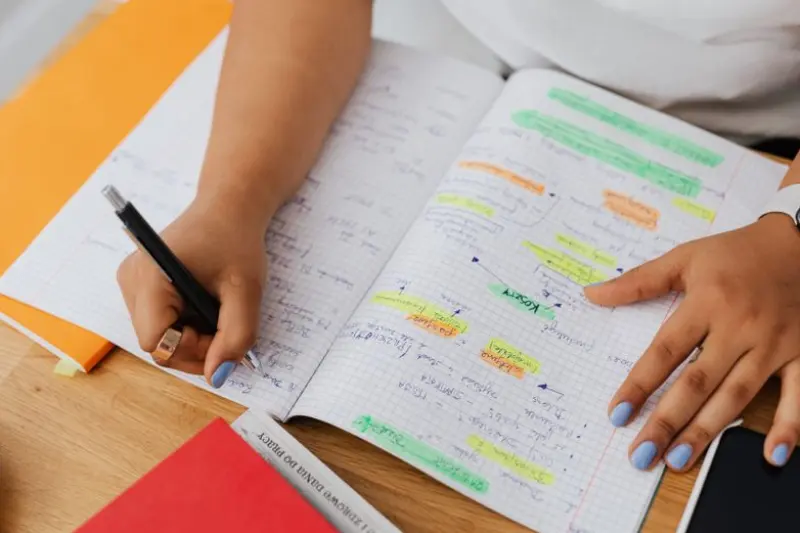
What a GCSE preparation run actually covers
Revision goes wrong in a predictable way. A pupil opens a revision guide, reads a page they already know, feels busy, and closes it. Six weeks later the same weak topics are still weak. Our GCSE exam preparation goes the other way: we start with the exam board specification, find the gaps, and build a short list of topics that will move the grade first.
The first lesson is a working assessment, not a chat. The pupil brings a recent mock paper, a class test or a completed past paper. We mark it against the mark scheme, look at question-level marks, and link every lost mark to a topic. AQA, Edexcel, OCR and WJEC phrase questions in different ways, so we use the right board's papers and the right tier, Foundation or Higher. You leave that lesson with a plain summary of what is secure, what is fragile, and what has not been taught yet.
After that, lessons move between three activities. Re-teaching a weak topic. Rehearsing it under exam timing. Reviewing the marks together. A typical hour might include twenty minutes on rearranging formulae, a timed 20-minute section from a calculator paper, then a mark-scheme review where we name the reason for each lost mark: method, accuracy, unit, presentation or a misread question.
Who it suits and who it does not
This run suits a pupil in Year 10 or Year 11 who has mock results, a school report or a clear sense that one subject is holding the rest back. It also suits the pupil whose knowledge is reasonable but whose timing collapses in the exam hall. We teach maths, English and science at GCSE, and we provide tutoring for school pupils aged 7 to 18, so the same planning method carries into younger years when a family wants an early start.
It does not suit every situation. If a pupil has missed two years of a subject and the exam is in six weeks, a short run cannot cover the whole specification. We will say so. It is also a poor fit for a pupil who wants a group class with friends and no between-session work. One-to-one lessons ask for attention and a little practice between sessions. Families who want a tutor to sit alongside a school teacher and quietly fill gaps tend to get the most from it.
Honesty matters here. No tutor can promise a grade, and anyone who does is selling something you cannot verify. What we can do is name the topics, rehearse the timing and show you the mark-scheme evidence as it builds.
How a run of lessons works, step by step
1. A short call before booking
We ask for the exam board, the tier, the subject and the date of the next mock or exam. We also ask what the school has already covered. This takes ten minutes and saves a wasted first lesson.
2. The first lesson
The pupil works through a short diagnostic paper or a recent mock. The tutor marks it live and talks through the decisions. We deliver one-to-one lessons online or at home, so the setting is either a quiet room with a shared screen or your own table. Both work. The diagnostic is the same.
3. The topic plan
You receive a short written plan: six to twelve topics, ranked by impact, with the exam board wording beside each one. It is not a copy of the syllabus. It is the part of the syllabus worth doing first.
4. Weekly lessons and timed practice
Every lesson has a worked example, a guided attempt and an independent attempt. Between sessions the pupil gets a small task, usually 20 to 30 minutes, drawn from the same paper. Little and often beats a three-hour Sunday cram.
5. Review and progress reports
After each block of lessons we review the marks. Progress reports for parents are written in plain English: what is now secure and what still needs work, plus the next steps. You are not left guessing from a smile at the door.
What to bring or prepare before the first lesson
A few things make the first lesson sharper. You do not need all of them, but the more you bring, the less time we spend guessing.
- The exam board and tier for each subject, for example AQA Higher maths or Edexcel Combined Science.
- A recent mock paper, class test or school report. A photo of the paper is fine.
- The pupil's exercise book or a list of topics the school says are complete.
- A calculator, a ruler, a pencil and paper. For English, the set texts and any school annotations.
- For online lessons, a quiet room, a working microphone and a camera. Headphones help.
- For home lessons, a table with space for two people and the paper. A Tuesday in February works better than a kitchen full of people.
If you are unsure of the exam board, check the school website or ask the class teacher. We can usually identify it from a past paper, but it saves a step.
What affects the timing and the cost
The start date is the biggest factor. A run that begins in the autumn can re-teach whole topics and revisit them twice. A run that begins after the Easter holidays in Edinburgh has to choose its targets carefully and spend more time on exam technique. Neither is wrong. They are different jobs.
Other factors: the number of subjects, the tier, the frequency of lessons and the length of each lesson. Online lessons remove travel from the diary. Home lessons add travel time for the tutor, which can affect which slots are available. We agree lesson length and frequency before the first lesson, and we review both after the first block. Lesson fees are quoted on request because a plan for one subject and a plan for three subjects are not the same piece of work.
We do not publish a rate card on this page. Call +44 131 4752394 or email [email protected] and we will talk through the options. We confirm lesson times when you book.
How this compares with DIY revision, apps and large group classes
DIY revision is cheap and can work for a confident pupil. The problem is feedback. A pupil can practise a question, get it wrong, and never learn why the mark scheme wanted a different method. We mark against the board's scheme and explain the gap in the room.
Revision apps are good for recall. They are poor at exam timing. A multiple-choice quiz does not teach a pupil to spend 12 minutes on a six-mark question and move on. Our lessons include a visible clock, a set paper and a review of the decisions made under pressure.
Large group classes can be useful for motivation. They cannot stop for one pupil who has misunderstood the difference between a substitution and a rearrangement. We teach one to one, online or at home. Our DBS-checked qualified tutors plan each lesson around the pupil in front of them, and progress reports for parents keep the work visible between lessons.
Doing nothing is also a choice. If a pupil is on the edge of a grade boundary, a planned run of lessons can target the handful of marks that separate one grade from the next. We cannot say by how much. We can show you which questions are costing marks and what we are doing about them.
Questions parents ask
How many lessons will be needed before the GCSE exams?
There is no fixed package. A pupil with one weak topic may need a short run. A pupil rebuilding a whole paper may need a longer run across a term. We review after the first block and tell you plainly whether the plan is working.
Do you follow the same exam board as the school?
Yes. Tell us the board and tier, and we use that board's past papers and mark schemes. If the school has not confirmed the board, we can usually work it out from a recent paper.
Can lessons be online or at home?
Both. We deliver one-to-one lessons online or at home, subject to availability in your area. Online lessons need a quiet room and a stable connection. Home lessons need a table and the pupil's papers.
Are the tutors qualified and DBS-checked?
Yes. Our DBS-checked qualified tutors work with pupils aged 7 to 18 across maths, English and science. We match the subject and the year group before the first lesson.
How will I know if it is helping?
You get progress reports for parents after each block. They list what is now secure, what still needs work and the next steps. You can also ask for a short call after any lesson if something needs to change.